Daniel T. Neely
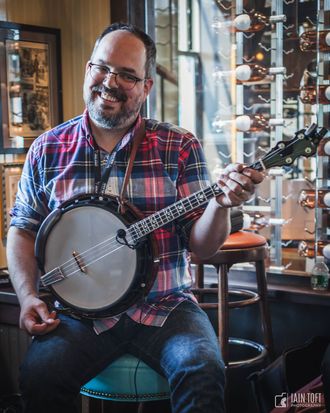
Daniel is a musician and ethnomusicologist with specialties in the musics of Ireland and Jamaica. He received the Ph.D in Musicology from New York University in 2008.
Since 2012, he's written the weekly column about traditional music for New York's Irish Echo newspaper, is a member of Ward Irish Music Archive's board of directors, and has taught classes about Irish music on the master's level at NYU's Glucksman Ireland House. From 2008-2023, he was the Public Relations Officer for the Mid-Atlantic Region of Comhaltas Ceoltoirí Éireann (North America's largest region of the world's primary Irish organization dedicated to the promotion of the music, song, dance and the language of Ireland) and from 2012-2016 he was the artistic director of the Augusta Irish Week in Elkins, West Virginia. In addition, he led the popular traditional music session at Lillie’s Bar and Restaurant in Manhattan from 2009-2017, he played tenor banjo with the champion New York Céilí Band in 2016-2017, and from 2005–2013 he led the Washington Square Harp and Shamrock Orchestra, a New York-based group modeled on the Irish-American dance bands of the 1920s and 1930s. He learned to play the tenor banjo with Mick Moloney and is a fiddle student of Brian Conway's. Daniel's research focus has concentrated on Irish music in America, particularly as it was played in Boston, Massachusetts in the period 1890-1930 by musicians including Daniel Sullivan, Dan J. Sullivan, William & Michael Hanafin, Shaun O'Nolan, and others who were involved with the "Dan Sullivan Shamrock Band." He has given invited lectures on this material and on Irish Music in general at Boston College, Technical University Dublin, the Catskills Irish Arts Week, the Ward Irish Music Archives, Na Píobairí Uilleann in Dublin, Ireland, and elsewhere.
In 2000, Daniel began a research project in Jamaica about mento music. This fieldwork was supported by several grants, including a Fulbright and NYU’s Dean’s Dissertation Fellowship, which resulted in his dissertation, “Mento, Jamaica’s Original Music”: Development, Tourism and the Nationalist Frame. His research in Jamaica led to essays in Sun, Sea and Sound: Music and Tourism in the Circum–Caribbean (Oxford University Press, 2014; also, co-edited with Tim Rommen), Creolizing Contradance in the Caribbean (Temple University Press, 2009; with Ken Bilby), Victorian Jamaica (Duke University Press, 2018), Jamaica Jamaica! (Philharmonie de Paris, 2017), the Concise Garland Encyclopedia of World Music (2008), and elsewhere. He also performed on and was music director of the Jolly Boys mento band’s 2010 album Great Expectation, was the special consultant and advisor for the documentary Pimento and Hot Pepper: The Story of Mento Music (Best Documentary, 2017 Palm Bay Caribe Film Festival; Official Selection, 2017 Trinidad + Tobago Film Festival), and was an organizer and invited lecturer for the Institute of Jamaica's 2017 Grounation conference on mento.
In 2000 he began looking at the history and aesthetics of ice cream truck music. Early on in his research, he presented his findings at a few different academic meetings, which led to an essay in Esopus magazine (2005), that was later anthologized in The Esopus Reader (2022). He also produced a long essay on the subject in the Oxford Handbook of Mobile Music Studies (Oxford University Press, 2014). He has spoken on the subject with a variety of news and media outlets over the years, including the New York Times, the Washington Post, and America's Test Kitchen's podcast.
Finally, in the late 1990s Dan played guitar in a Boston-based ska band called Skavoovie and the Epitones. In September 2024, Skavoovie will reunite to play the Supernova International Ska Festival.