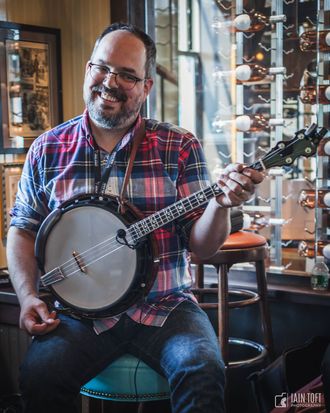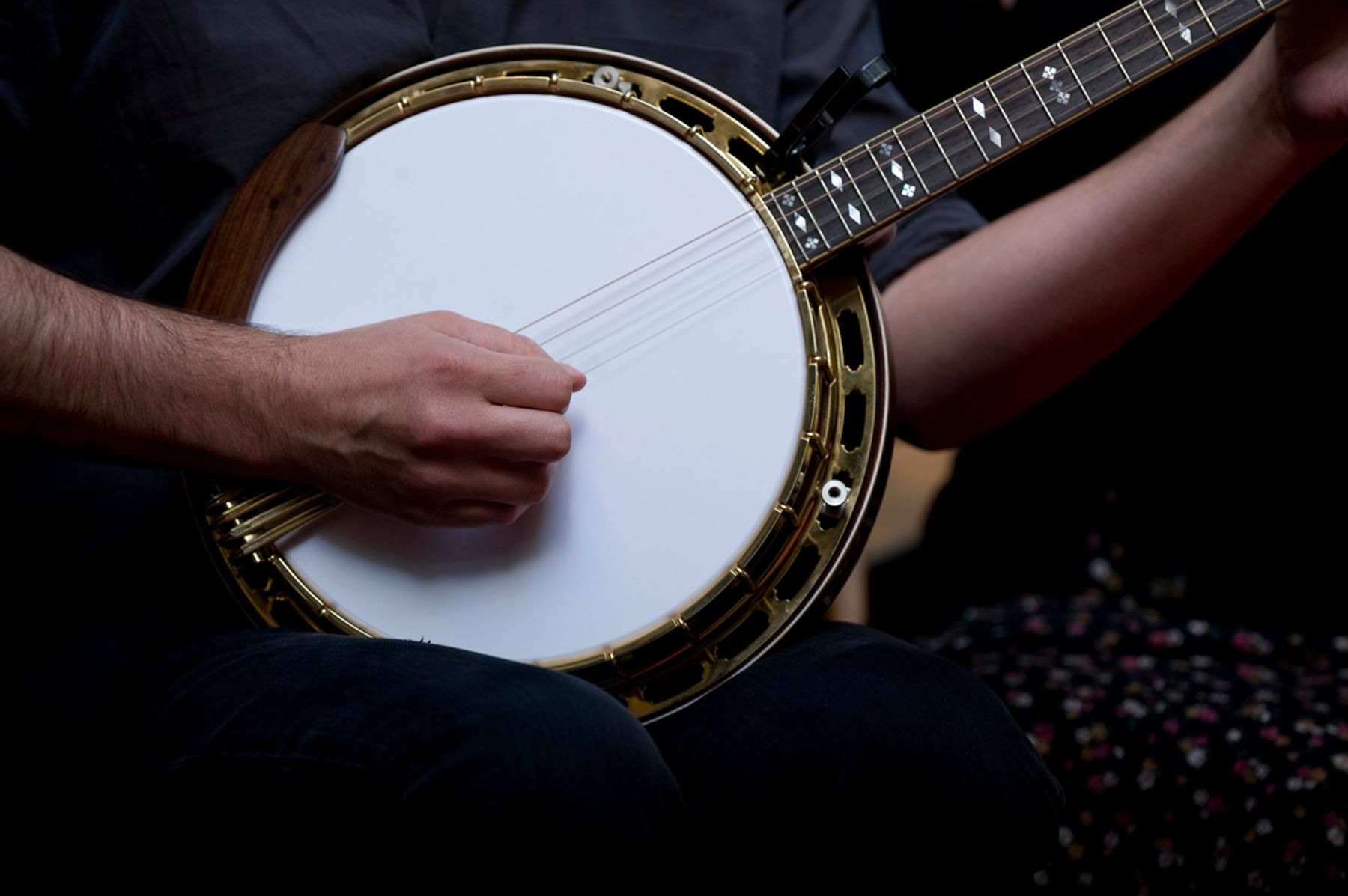
The Washington Square Harp and Shamrock Orchestra is gearing up for a busy St. Patrick’s season. Not only has Donie Carroll released a solo album, but we’ve been recording. Here are some photos from one of the sessions:
I am grateful to Dan Milner, one of the group’s singers, for taking these pictures.
I read a website called the Banjo Hangout. It’s an interesting place where banjo players (mostly of the bluegrass and old timey persuasion) come together and talk about all things banjo. One discussion that’s happening at the moment is about the etymology of the word “banjo.” In the thread, one poster provided a chronological list of published variants of the word “banjo,” to which another poster replied that “Merrywang” had been lost from the list. (I imagine that the list was in part based on Appendix II, “Table of sources for the Banjo, Chronologically Arranged” in Dena Epstein’s Sinful Tunes and Spirituals.) This got me thinking: I had, of course, come across the term “merry wang” in banjo histories and in histories of Jamaican music fairly regularly. However, no Jamaican banjo player I ever met while doing my PhD research in Jamaica ever mentioned it or seemed to know anything about it. While I didn’t really follow the etymology of the word banjo in any rigorous way as I scoured archival sources, I did notice the ones that did use the term (including those from the eighteenth century) felt repetitive and felt poorly researched to me. So, this morning I revisited some of what I’d noticed, and based on this I want to suggest that the historical use of “merry wang” as a word for banjo is either an unreliable etymological outlier, or a red herring all together. I just don’t think that the word was as commonly used as historians think and can likely be attributed to a single eighteenth source–the Long family.
Most familiar with the term “merry-wang” will know it through Edward Long’s History of Jamaica (1774). Here’s the relevant passage:
Long’s book wasn’t the merry wang’s first appearance in print, however; the term is found in an anonymous poem called “The Pleasures of Jamaica,” written from “an Epistle from a Gentleman to his friend in London” and published in The Gentleman’s Magazine, and Historical Chronicle, 1738:
Unfortunately, we don’t know who wrote this poem. While it appears to be written as a heroic couplet, we also don’t know what the “merry-wang” is — in this context, the term’s meaning is not obvious. However, this source and Long hyphenate it–others don’t, really–which makes me think they’re related. The community that would have sent a poem like this from Jamaica in was fairly small. Since the published record suggests that the merry wang was not a widely-known or widely-used a term, I suggest that the poem’s author was likely a member of, or someone closely related to, the Long family. A British colonial administrator and historian, Edward Long wasn’t born until 1734. However, Long’s family had been in Jamaica since 1655. His great-great grandfather was in the British army and established the family as part of the planter elite. They owned slaves and would have had some familiarity with their activities. Could “merry wang” have been the name someone in the family gave to the instrument or perhaps the name a slave gave them to make it intelligible to colonials? Or is it a name a slave provided to keep it’s African name a secret?
We can’t know. While I admit the suggestion is based on pretty flimsy circumstantial evidence, it is really no more flimsy than claims that (as Gura and Bollman suggest) “these terms were so common [by the late eighteenth century] that upon visiting Sierra Leone Thomas Winterbottom described a native instrument as like “the banja or merrywang, as it is called in the West Indies” (emphasis mine). Based on this evidence, I not only think merry wang was not a common name in the West Indies, it wasn’t a common name in Jamaica, and further, it may not have been used at all. In fact, I think that the only people with whom this term had any currency were those familiar with Edward Long’s (and later, Bryan Edwards and T. M. Winterbottom’s) work. How might we test this notion?
First off, if the term was so common, we might expect to find it mentioned elsewhere. And we do…sort of (keep reading). It’s not used everywhere and one place we don’t find it is in William Beckford’s A Descriptive Account of the Island of Jamaica (1790), an account of Jamaica fairly contemporaneous with that of Long (and others):
No merry wang. The citation in Gura and Bollman I mentioned above led me to the hilariously named Thomas Masterman Winterbottom, who mentioned it his An account of the native Africans in the neighbourhood of Sierra Leone (1803). I’ll include the relevant passage again:
This mention is important because Winterbottom’s cited source was Bryan Edwards’s 1793 History of the West Indies. Turns out, Winterbottom had no firsthand encounter with a merry wang and relied on someone else’s work. And what did Edwards have to say on the subject?
Edwards was a Jamaican planter and politician. His book was translated into several languages, went in five editions “and became the standard history of the british West Indies and a starting point for other works.“ In compiling his book, he borrowed elements of Long’s work (and others), including, I think, this bit on the merry-wang. A quick note on spelling: unlike the orthographic similarity between the 1738 and 1774 sources, I don’t think the spelling difference between these two later sources is important. Winterbottom, who cited Edwards spelled it merriwang; Edwards himself had it as merrywang. I think the earlier orthographic consistency is more telling than this and later discrepancies. (BTW, Long and Edwards were a couple peas in a pod in that both was an extreme racist. The niceties of slave culture were not high on either’s list and I think it’s fair to suggest that the amount of primary research either did on the music was negligible. What’s clear [to me, at least] is that each conveyed only easy-to-procure information: Long, as I suggest above, got his from a family member; Edwards took his from Long.)
SO, these sources lead me to a spate of later sources that helped legitimate the existence of the merry wang as an unobserved but still “real” thing in the 19th century. Some of these sources cite the original sources, some don’t. You find it in the midst of blatant plagiarism, as in Robert Renny’s An history of Jamaica: with observations… (1807).
The astute among you will recognize that Renny lifted this passage almost directly from Edwards. Mary Elizabeth Capp, on the other hand, mentions her source in The African princess: and other poems (1813):
Other sources offer no citation, but in context it’s usually pretty obvious that a source is being used. For example, in Canto V, verse XV of Edwin Lawrence’s Xamayca, a romantic poem (1847) he writes:
The inclusion of the goombeh, by the way, is interesting because Long describes it in the paragraph following the one in which he describes the merry wang.
We find Long’s telltale influence in Theodora Elizabeth Lynch’s Years ago: a tale of West Indian domestic life of the eighteenth century (1865), where she wrote:
Gardner was writing in retrospect (he says “was,” not “is”) and seems again to have been borrowing from Long (“rude”).
When people started to “discover” Jamaican culture in the twentieth century, the merry wang had become an accepted Jamaican musical instrument and no one questioned its existence. For example, in an account of the musical instruments of Jamaica in her 1929 book Black Roadways, anthropologist Martha Beckwith talks about it. Her sources? The “eyewitness” accounts of Beckford (who didn’t mention it), Edwards and Long. She never claims to have seen one.
And this is the problem, because this sort of thing happened in other published sources. Early writers became de facto trusted sources and nobody ever thought to (or maybe just never bothered to) question their veracity or reliability. Variations of the word “banjo” throughout the new world are, I think, probably often explainable by differences in transliteration. But “merry wang” is a weird one. Given this pattern of repetition and unsubstantiated citation I’ve outlined here, I can’t see it now as anything other than illegitimate and an a etymological distraction in the banjo’s history.
Last week I was in Jamaica on a very successful instrument buying trip for the Musical Instrument Museum. After I’d finished the Montego Bay-based leg of my work, I took an hour the evening before I drove to Kingston to visit with my old friend Hedley Jones, O.D. A musician, inventor and astronomer, he’s an all around remarkable guy. Born in Wakefield, St. Catherine in 1917, he began his professional life as a newspaper proofreader. Then, in 1944, he became a radar engineer for the Royal Air Force. The technical skills he developed in the RAF allowed him to do all sorts of things. For example, he opened a radio repair business:
Sunday Gleaner, June 27, 1948, p.2
He also built and demonstrated Jamaica’s first traffic lights with his cousin Stephen in 1952. More recently, he got into astronomy and built his own telescopes (he’s built both 4″ and 6″ refractor models and ground his own lenses for them).
But these activities pale in comparison to his contributions to music. Hedley began his musical life as a tenor banjoist, but quickly switched to guitar, jazz being his main musical love. He had a long career as a player and between 1985 and 1995 was the President of the Jamaica Federation of Musicians. His impact as both a luthier and electrical engineer was substantial. In the video above, Hedley describes how he invented the first six-string electric solid body guitar in 1939-40. Yes, invented. Don’t worry, I was skeptical when he first told me about this too, so I looked it up in the Jamaica Gleaner newspaper and found fairly compelling photographic evidence from 1940 to support this claim:
Click for full view
This means that Jones’s work predates the construction of Les Paul’s “Log,” which most sources (including the Gibson Guitars, the New York Times, and the Rock and Roll Hall of Fame) date to 1941. I’ve seen Jones’s guitars referred to in print as “automatic guitars” or simply, “Jones guitars.” Between 1940 and 1944, he built several such instruments for other guitarists in Jamaica as well as some for members of the USA war services band stationed at the army base in Vernam Field, Clarendon. Later on, he also built several double-necked or “twin electric guitars,” the first being a guitar and five string bass combo in 1961.
Hedley’s other substantial contribution to Jamaican music is that he built some of Jamaica’s first (and most important) sound systems, for operators like Tom Wong (a.k.a. Tom the Great Sebastian), Roy Johnson, and Arthur “Duke” Reid. In addition, he had several protégés who built systems for others, like Clement “Coxone” Dodd. Jones’s expertise as an RAF-trained electrical engineer served him well and made him top in his field; this background is likely why Mr. Dodd asked Jones to help him build the original Studio One in 1963.
Jones’s legacy is largely neglected in Jamaica. However his contribution to Jamaican music history and his role in global sound studies really cannot be overstated. Let’s hope that more will pay attention to his musical and technical legacy.
Between November 3rd and 12, I was in Jamaica at GeeJam Studios to work on Jon Baker’sJolly Boys recording project. Months ago, Jon came up with an idea to invite the Jolly Boys (featuring Albert Minott, a Jolly Boy from the early 1960s who took a long hiatus to perform in north coast floor shows) into the studio and ask them to take on something different from the “island music” repertory that makes up a large part of what they play. The tunes Jon chose were mostly rock tracks from the 1970s-2000s (including songs by The Stooges, Lou Reed, The Doors, Amy Winehouse, as well as some more modern Jamaican repertory from the likes of Sean Kingston and others) that are well outside the comfort zone of most mento bands. Charged with adding some modern but mento-inspired riddims (which turned out wicked) was Dale “Dizzle” Virgo, GeeJam’s studio manager and chief engineer. My job was to play banjo and perhaps even to offer a little of my doctoral expertise with mento to round out the album’s sound. Anyhow, I took some short videos of the experience and edited together a little thing that I’ve put up on the Youtube. Have a look:
As you might hear from a couple of the clips here, it’s not a “traditionalist” album, rather, it’s a modern take on the tradition that I hope raises awareness of the music and widens the creative and commercial possibilities for others playing it today.
The Washington Square Harp and Shamrock Orchestra played at a members event at NYU on Friday, November 13. It was a fun evening and here’s a short video I put together documenting what we did:
On October 9, 1948, Jamaica police shot and killed Ivanhoe Martin on Lime Cay in Jamaica. “Rhygin,” as he was more popularly known, was a gangster and a folk hero and, as many know, the inspiration for Perry Henzell’s The Harder They Come, a Jamaican film starring Jimmy Cliff as Ivan Martin. Although he was buried in a Pauper’s lot in May Pen Cemetery in Kingston shortly after he was killed, Rhygin’s memory has been kept alive for decades, largely through Henzell’s work. What many don’t know, however, is that the iconic two-gun image of Cliff-as-Ivan (as seen below) was not only based on photos actually taken of Rhygin when he was alive, but that Rhygin’s story was first appropriated for dramatic purpose in early 1948 in a Jamaican stage production called Rhygin’s Ghost by comedians Bim and Bam. Then, in 1966, Rhygin was the basis for a well-known poem Louise Bennett called “Dead Man”:
Wen smaddy dead dem dead fe true!
Koo yah, koo police man!
Tan up over Rhygin an dah-
Finga-print up him dead han!
*****
Koo dem fus pictures him pose fah.
Gun dem ready, blazin lead!
Koo de las picture him pose fah
Eena dead house, lidung dead!
But ah wanda wat would happen
To de picture-man Miss Sue?
Ef wen him dah-teck de picture
Rhygin duppy did sey “boo”!
Below are some images to tie this together. From top left, pictures 1 & 2 are of Rhygin in two-gun style; picture 3 (top, left) shows Rhygin dead on the beach and (right side) a police man “tan up over [him] and da finga-print up him dead han”; picture 4 is the image Bim and Bam used to advertise their production of Rhygin’s Ghost (Bim and Bam were friends of Bennett’s by the way–just FYI); and, pictures 5 & 6 are the images most will be familiar with (the first from a promo for the movie, the second appropriated by US-based reggae label Version City for a t-shirt). Many of the pictures are kind of lousy–I don’t have easy access to the actual newspapers at the moment, but these should be good enough to give y’all a sense of the history at play here.
Rhygin’s legacy lives on today, in a bit of global, historical consistency (beyond the movie’s continued marketing), as musical theater:
Anyone seen it? Looks like it might be pretty good…
I spent the last week at the Center for Black Music Research at Columbia College in Chicago on a little travel grant to track the Sankey repertory in Jamaica (and to a [much] lesser extent, other Caribbean islands) through field recordings. I found SO much great stuff, so I got some great material to think through for the next little while. The CBMR is a wonderful place, everyone there is great and they have all sorts of incredible stuff. A totally worthwhile trip.
In other news, I posted the following link on Victor Rice’s Facebook wall and thought it might be nice to put it here. It’s a 1939 film called The Devil’s Daughterthat was also released as Pocomania (it wasthe all-black version of a 1934 film released variously as Love Wanga, Ouanga, and The Crime of Voodoo;the 1939 film is far superior because it actually, you know, entertains). It is fascinating and includes some great performances (including, in this clip, what is probably the earliest footage of Jamaican hand drumming). The whole thing is worth watching, so here’s the first segment to get started:
A woman asked her grandmother how her grandfather had died. “He had a heart attack while we were making love one Sunday morning,” Granny said. Horrified, the granddaughter told her that two people that old having sex would surely be asking for trouble. “Oh, no,” said Granny. “Many years ago we realized that ringing church bells provided the perfect rhythm: in on the ding and out on the dong.” She paused, wiped away a tear, and continued, “But then the ice-cream truck came along.”
I’ve recently submitted an article about ice cream truck music to a book that will come out sometime next year on Oxford…having been pretty close to the subject for a little while, it’s entirely possible my perception of how funny this joke is is somewhat skewed (but somehow I don’t think so).